

Reviewed by: Dr. G. Praveena Ragunanthan, Senior Consultant – Obstetrics, Gynecology, Reproductive Endocrinology & Infertility, and Director, Rathimed Speciality Hospital, Anna Nagar, Chennai. MS (OB-GYN), Diploma in Reproductive Medicine, Kiel University, Germany. 10+ years of clinical experience.Infertility isn’t only a woman’s issue — male factors are involved in roughly half of all cases where couples struggle to conceive. Yet the causes of male infertility often go undiagnosed for years, partly because they rarely produce obvious symptoms and partly because male fertility isn’t discussed as openly as female fertility.
This guide walks through the different types of male infertility, the most common causes, how doctors diagnose them, and which treatments actually work — so you know what to expect if you or your partner are trying to make sense of a fertility diagnosis.
Overview
Male infertility means a man is unable to contribute effectively to conception, usually because of a problem with sperm production, sperm function, or the pathway sperm need to travel to reach an egg. The causes of male infertility range from hormonal and genetic conditions to everyday lifestyle habits — and importantly, most of them are treatable once identified.
Types of male infertility
Fertility specialists generally describe two types of male infertility:
- Primary infertility — a man has never fathered a child despite regular, unprotected intercourse over at least a year.
- Secondary infertility — a man has fathered a child before but is now unable to conceive again.
Both types can stem from the same underlying causes, so the distinction mainly helps doctors understand the timeline and rule out newly developed issues, such as an infection or injury, in secondary cases.
Male infertility symptoms to watch for
Male infertility symptoms are often silent until a couple has been trying to conceive for a while without success. When symptoms do appear, they can include:
- Difficulty conceiving despite a year or more of regular, unprotected intercourse
- Reduced facial or body hair, often linked to hormonal imbalance
- Erectile dysfunction or trouble maintaining an erection
- A low sperm count — usually only detectable through a semen analysis
- Pain, swelling, or a lump in the testicles
- Unusual discharge or other signs of a reproductive tract infection
None of these symptoms confirm infertility on their own, but noticing any of them is a good reason to get evaluated rather than wait.
What are the causes of male infertility?
Hormonal imbalance
Sperm production depends on a tightly regulated hormonal system involving the brain (hypothalamus and pituitary gland), the testes, and the thyroid. When this system is disrupted, sperm output and quality both suffer — making hormonal imbalance one of the more frequently diagnosed contributors to male infertility.
- Low testosterone — whether from aging, injury, or an endocrine disorder — reduces sperm count and can lower libido.
- FSH and LH imbalance — follicle-stimulating hormone and luteinizing hormone, both released by the pituitary gland, directly control sperm development in the testes. Disruption here can reduce sperm count or, in severe cases, stop production altogether.
- Thyroid disorders — both an overactive and an underactive thyroid can impair sperm motility and shape, and affect libido.
- High prolactin levels — elevated prolactin suppresses testosterone and can cause erectile dysfunction alongside reduced sperm production.
The good news is that hormonal causes are usually straightforward to detect with a blood test and often respond well to medication once identified.
Varicocele
A varicocele — enlarged veins in the scrotum, similar to varicose veins in the legs — is one of the most frequently diagnosed causes of male infertility. The extra blood pooling raises the temperature around the testicles, which interferes with sperm production and quality.
Typical signs: a dull ache in the scrotum, visible or palpable enlarged veins, and reduced sperm count or motility on semen analysis.
Treatment: Surgical repair (varicocelectomy) is the standard fix and frequently restores sperm parameters. Rathimed’s varicocele treatment programme covers diagnosis through minimally invasive repair.
Infections
Certain infections can scar or block the reproductive tract, or interfere directly with sperm production, making them one of the more preventable factors behind infertility in men.
- Sexually transmitted infections such as gonorrhea or chlamydia
- Mumps contracted after puberty
- Urinary tract infections that spread to the reproductive organs
Watch for painful ejaculation, blood in semen, or testicular pain and swelling — these symptoms are most closely tied to an active or past infection. Antibiotics resolve most active infections, though scarring from long-standing or repeated infections sometimes needs surgical correction.
Genetic conditions
Some fertility problems are present from birth:
- Klinefelter syndrome — an extra X chromosome that lowers testosterone and impairs sperm production.
- Y chromosome microdeletions — missing genetic material on genes responsible for sperm development.
- Cystic fibrosis-related absence of the vas deferens — some men with cystic fibrosis are born without the tube that carries sperm from the testes.
Men with a genetic cause typically need assisted reproductive technologies such as ICSI, sometimes combined with surgical sperm retrieval, to father a biological child. Genetic testing at Rathimed helps pinpoint the exact issue before deciding on a treatment path.
Lifestyle factors
Everyday habits have a measurable effect on sperm health, sometimes as much as an underlying medical condition:
- Smoking damages sperm DNA and lowers sperm count.
- Excessive alcohol reduces testosterone production and sperm quality.
- Recreational drug use and anabolic steroids can suppress sperm production significantly.
- Obesity raises estrogen levels, which in turn lowers sperm output.
- Chronic stress disrupts the hormonal signals needed for healthy sperm production.
- Poor diet, especially one low in zinc, antioxidants, and key vitamins, weakens sperm count, motility, and shape.
- Prolonged heat exposure — tight underwear, laptops on the lap, or hot tubs — can raise scrotal temperature enough to affect sperm quality.
Unlike genetic or structural causes, lifestyle-related factors are within a man’s control, and improvements here often show up in semen parameters within about three months — roughly the time it takes for new sperm to mature.
Blockages in the reproductive tract
A blockage anywhere along the path sperm travel — from the testes to the urethra — can prevent sperm from appearing in the ejaculate at all, even when production itself is normal.
Common causes: prior vasectomy, scarring from infections such as epididymitis, or a congenital absence of the vas deferens (often linked to cystic fibrosis).
Many blockages can be surgically repaired or bypassed, and sperm can often be retrieved directly for use in ICSI even when a blockage can’t be fixed.
Sperm quality issues
Even when sperm are present in normal numbers, their quality determines whether they can fertilize an egg:
- Low sperm count — generally defined as fewer than 15 million sperm per millilitre of semen, based on WHO reference values.
- Poor motility — sperm that don’t swim well enough to reach the egg.
- Abnormal morphology — irregularly shaped sperm that struggle to penetrate the egg.
Depending on severity, treatment ranges from lifestyle changes and medication to IVF or ICSI, where a single healthy sperm is injected directly into an egg.
Azoospermia: when there’s no sperm in the ejaculate
Azoospermia — the complete absence of sperm in the semen — deserves its own mention because it’s one of the more serious forms and affects a meaningful share of men evaluated for infertility. It falls into two categories:
- Obstructive azoospermia — sperm are being produced normally, but a blockage (from a vasectomy, infection scarring, or a congenital absence of the vas deferens) stops them from reaching the ejaculate. Surgical correction or direct sperm retrieval usually works well here.
- Non-obstructive azoospermia — the testes are producing little or no sperm, often due to hormonal, genetic, or testicular causes. This form is harder to treat, but techniques like testicular sperm extraction (TESE) combined with ICSI have made biological parenthood possible for many men who once had no options.
Because azoospermia can occasionally signal an underlying condition such as a genetic disorder or, rarely, testicular cancer, it’s one of the findings doctors investigate most thoroughly during a fertility work-up.
Male infertility vs. female infertility: why both partners need testing
It’s a common misconception that fertility testing is a “female” step. In practice, roughly a third of infertility cases involve male factors alone, another third involve female factors alone, and the remainder involve a combination of both — or no clearly identifiable cause. Because male-factor infertility is just as common as female-factor infertility, most clinics, including Rathimed, recommend evaluating both partners at the same time rather than testing one first and the other later. This shortens the diagnostic timeline considerably and avoids months of delay if the issue turns out to involve both partners.
Risk factors for male infertility
Some factors don’t directly cause infertility but raise the likelihood of it:
- Lifestyle choices — smoking, heavy drinking, and drug use
- Underlying medical conditions — diabetes, obesity, and hormonal disorders
- Environmental exposure — chemicals, radiation, or prolonged heat exposure at work
- Age — less influential than in women, but sperm quality does gradually decline with age, particularly after 40–45
Recognizing these risk factors early makes it easier to address the causes of male infertility before they progress into a diagnosed fertility problem.
Diagnosis and tests
A fertility work-up usually starts broad and narrows down based on the findings. Recognizing male infertility symptoms early — and not waiting to bring them up with a doctor — often shortens this process considerably.
- Medical history and physical exam — lifestyle habits, past illness, and family history, plus a physical check for structural abnormalities.
- Semen analysis — measures sperm count, motility, and morphology. This single test uncovers the underlying issue in a large share of cases and is usually the first test ordered.
- Hormone testing — blood tests for testosterone and related hormones.
- Genetic testing — identifies inherited conditions affecting fertility.
- Scrotal ultrasound — detects structural issues such as varicoceles.
- Testicular biopsy — occasionally used to directly assess sperm production in the testes.
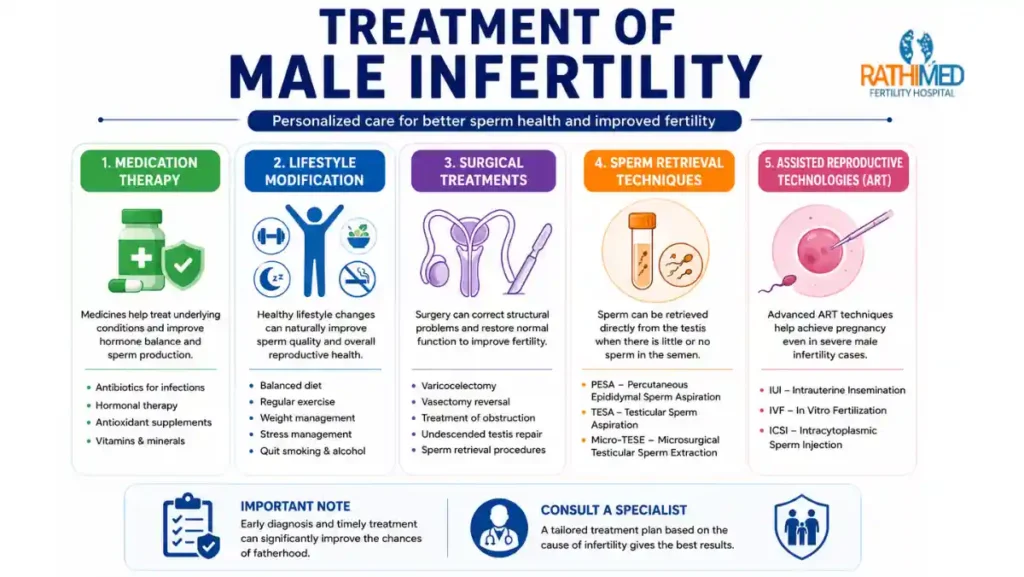
Treatment of male infertility
The treatment of male infertility depends entirely on the underlying cause identified during diagnosis:
- Medication for infections, hormonal imbalances, or certain sperm quality issues
- Surgery for varicocele repair or to clear blockages
- Sperm retrieval procedures when sperm can’t be obtained through ejaculation
- Assisted reproductive technologies (ART), including IUI, IVF, and ICSI, for cases where natural conception isn’t possible
Most men diagnosed with a specific cause go on to have biological children with the right combination of treatment and, where relevant, lifestyle changes.
Possible complications
Left unaddressed, some types of male infertility can affect more than just the ability to conceive:
- Psychological strain — guilt, stress, or depression tied to the inability to conceive
- Relationship strain — communication gaps and emotional pressure between partners
- Underlying health signals — in rare cases, azoospermia can point to a genetic condition or, occasionally, testicular cancer, which is part of why a full diagnostic work-up matters
A timely diagnosis addresses the fertility issue and rules out these broader health concerns at the same time.
Prevention
Not every cause is preventable, but several habits lower the overall risk:
- Quit smoking and limit alcohol intake
- Maintain a healthy weight through diet and regular activity
- Avoid prolonged exposure to heat, chemicals, and environmental toxins
- Manage stress through exercise, sleep, or relaxation techniques
- Schedule regular health check-ups, especially if you have a family history of fertility issues
When to see a fertility specialist
If you and your partner haven’t conceived after a year of trying (or six months if your partner is over 35), it’s worth getting evaluated — for both partners, not just one. A semen analysis is a simple first step and often the fastest way to understand what’s going on. Book a consultation with Rathimed’s fertility team to get started.
Conclusion
The causes of male infertility are varied — hormonal, structural, genetic, infectious, and lifestyle-related — but the overwhelming majority are diagnosable and treatable. So, can male infertility be cured? In many cases, yes, or at least managed well enough for a couple to conceive, especially when the underlying cause is identified early. Understanding what’s behind a fertility problem is the first step toward effective treatment, and early evaluation gives you and your partner the widest range of options.