
If you are searching for miscarriage treatment in Chennai, you are probably dealing with a lot at once: physical symptoms, worry, and a long list of questions. This page explains how a miscarriage is confirmed, what your choices are, what recovery feels like, and when it makes sense to look for a cause. Our team at Rathimed Fertility Centre in Anna Nagar wrote it the way we would explain things in the consultation room.
What is a miscarriage?
A miscarriage is the loss of a pregnancy before the 20th week, although guidelines define the cut-off slightly differently. It is common. Roughly 10 to 20 percent of recognised pregnancies end this way, and most losses happen in the first 12 weeks. One miscarriage rarely means there is a problem with your fertility, and most women go on to have a healthy pregnancy.
Types of miscarriage
Doctors use different terms depending on what the scan and examination show:
- Threatened: there is bleeding, but the pregnancy is continuing and a heartbeat may still be seen.
- Inevitable: the cervix has opened and the loss cannot be stopped.
- Incomplete: some tissue has passed, but some remains in the womb.
- Complete: all the tissue has passed and the womb is empty on scan.
- Missed: the embryo stopped growing, yet there may be little or no bleeding. Many women find out at a routine scan.
- Septic: the womb is infected. This is an emergency.
- Recurrent: repeated pregnancy loss, covered further down.
Symptoms of miscarriage
The most common signs are:
- Vaginal bleeding, from light spotting to a heavy flow
- Cramping in the lower abdomen or lower back
- Passing clots or grey-pink tissue
- Pregnancy symptoms such as nausea or breast tenderness suddenly fading
Spotting does not always mean a miscarriage, and many women who bleed early on carry the pregnancy to term. Still, bleeding or pain should be checked with a scan. Pain on one side can also point to an ectopic pregnancy, which needs urgent care.
Go to emergency care if you have:
- Bleeding that soaks two or more pads in an hour
- Severe or one-sided abdominal pain, or pain at the tip of the shoulder
- Dizziness, fainting or a racing heartbeat
- Fever, chills or foul-smelling discharge
What causes a miscarriage?
In most cases nobody did anything wrong, and nothing could have changed the outcome. The common causes are:
- Chromosomal changes in the embryo. These account for about half or more of first-trimester losses. They are usually a chance error at conception, not something you inherited or caused.
- Uterine factors. A uterine septum, fibroids that distort the cavity, or scar tissue can interfere with implantation.
- Hormonal and metabolic conditions. Thyroid disease and poorly controlled diabetes raise the risk, and PCOS is linked to higher loss rates.
- Autoimmune conditions. Antiphospholipid syndrome is the best-established treatable cause of repeated loss.
- Infections. Serious infections, especially with high fever, can end a pregnancy.
- Age. Risk rises with maternal age, mainly because of chromosomal changes in eggs.
- Lifestyle. Smoking, heavy alcohol use and very high caffeine intake raise the risk. Everyday stress, exercise, lifting or sex do not cause miscarriage.
If you have PCOS, our PCOS clinic can help you get it under control before your next pregnancy.
How a miscarriage is diagnosed
The first job is to confirm what is happening and rule out an ectopic or molar pregnancy. We usually do:
- A transvaginal ultrasound to look at the sac, the embryo and the heartbeat. Sometimes we repeat the scan after a week before confirming, because dating can be a few days off.
- Blood tests, such as serial hCG, blood group with Rh type, and haemoglobin.
- An examination to check the cervix and look for infection.
After more than one loss, we also look for underlying causes (see the recurrent section below).
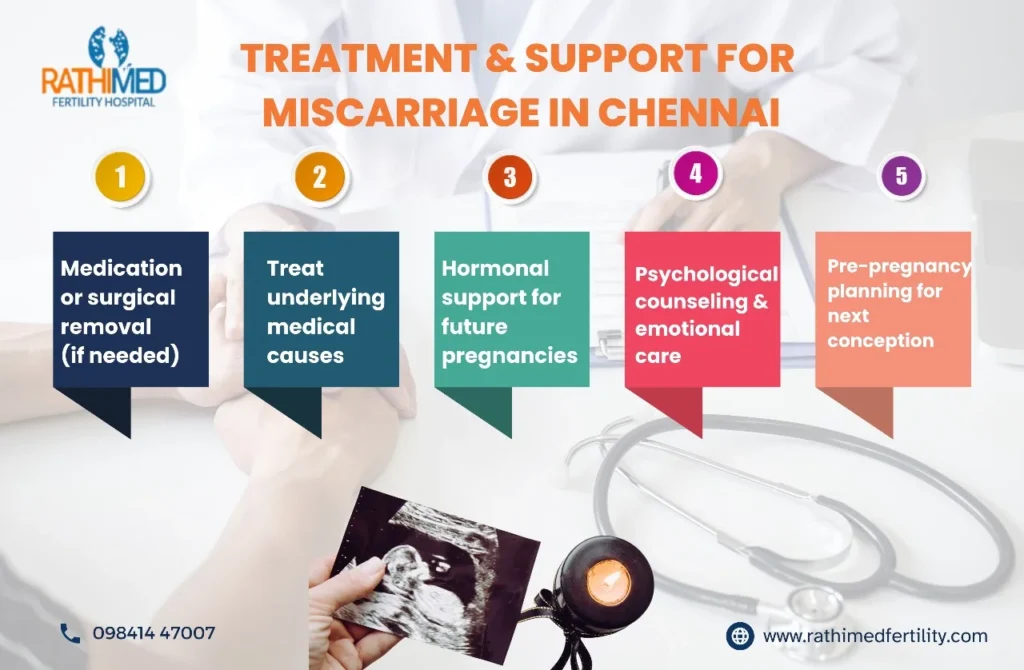
Treatment options for miscarriage
Miscarriage treatment in Chennai usually follows one of three routes: waiting, tablets or a short procedure. There is no single best treatment for miscarriage in Chennai or anywhere else. The right choice depends on how far along you were, how much you are bleeding, whether there is infection, and what you prefer.
Waiting for the body to pass the tissue
In many early losses the body finishes the miscarriage on its own within one to two weeks. You avoid medicines and procedures, but bleeding can be heavy and unpredictable, and a few women still need treatment later. We confirm with a repeat scan that the womb is empty.
Medicines
Tablets such as misoprostol, sometimes with mifepristone, help the womb empty. You are guided by your doctor and can often go home. Expect cramps and bleeding heavier than a period for some hours, then lighter bleeding for up to two weeks. We give pain relief and explain exactly when to call us.
A short surgical procedure
Suction evacuation (manual vacuum aspiration) or dilation and curettage (D&C) removes the remaining tissue. We advise it when bleeding is heavy, there is infection, or you are unstable, and some women simply prefer a quicker, more predictable option. It is usually a day-care procedure under anaesthesia or sedation.
Other care you may need
- Anti-D injection if you are Rh-negative, to protect future pregnancies
- Antibiotics if there is an infection
- A follow-up visit at one to two weeks to check recovery and plan next steps
The cost of miscarriage treatment in Chennai depends on the option you choose, whether you are admitted, and which tests are needed.
Recurrent miscarriage
RCOG defines recurrent pregnancy loss as three or more consecutive losses, and ESHRE as two or more. It affects a small share of couples, and in many of them a treatable cause is found. For recurrent miscarriage treatment in Chennai, we start with a careful history and then test for the causes that can actually be corrected.
Tests we may advise
- Blood tests for thyroid function, blood sugar (HbA1c) and antiphospholipid antibodies
- Uterine imaging such as 3D ultrasound, saline sonography or hysteroscopy
- Chromosome analysis (karyotyping) of both partners, in selected cases
- Testing of pregnancy tissue after a future loss, where possible
Treatments, depending on the cause
- Low-dose aspirin and heparin for antiphospholipid syndrome
- Hysteroscopic removal of a uterine septum or intrauterine adhesions
- Better control of thyroid disease and diabetes before conception
- Progesterone in early pregnancy for women who bleed and have had earlier losses
- Genetic counselling and, for selected IVF patients, preimplantation genetic testing. Its benefit is still debated, so we decide case by case.
In about half of couples no cause is found. That is frustrating, but the outlook is still encouraging: with early monitoring and emotional support, most go on to have a baby. We do not recommend immune treatments such as IVIG or steroids for unexplained loss, because current evidence does not support them.
If recurrent loss comes with difficulty conceiving, our IVF and frozen embryo transfer services, or a wider infertility evaluation, may help.
Recovery after a miscarriage
Physical recovery
- Bleeding usually lasts one to two weeks and slowly tapers off. Use pads, not tampons, until it stops.
- Your next period typically arrives in four to six weeks.
- A home pregnancy test can stay positive for a few weeks, so wait for your follow-up before retesting.
- Call us if bleeding turns heavy again, pain gets worse, or you develop a fever.
Emotional recovery
Grief after a miscarriage is real, whatever the stage. Sadness, guilt, anger, numbness and anxiety are all common, and partners feel it too, often in a different way and on a different timeline. Emotional care is part of miscarriage treatment in Chennai at our centre, not an add-on. Things that help:
- Talking to someone you trust, or to a counsellor
- Giving yourself time before deciding about another pregnancy
- Joining a peer support group
- Asking for help if low mood lasts more than a few weeks or affects sleep, eating or daily life
Trying again after a miscarriage
There is no single correct waiting time. Many doctors say it is physically safe to try once bleeding has stopped, and some women prefer to wait for one normal period to make dating easier. After surgery or a complicated loss, your doctor may suggest a longer gap. Feeling emotionally ready matters just as much.
To give the next pregnancy the best start:
- Begin folic acid (400 micrograms daily, or the dose your doctor advises) before you conceive
- Keep diabetes and thyroid conditions under control
- Stop smoking and avoid alcohol
- Aim for a healthy weight
- Book a preconception visit and an early scan
Our fertility wellness programme can help you prepare, and Low AMH care is available if age or irregular cycles are a concern.
When to see a doctor
Book a consultation if you:
- Have bleeding, cramping or pain in pregnancy (come in the same day if it is heavy)
- Have had two or more pregnancy losses
- Are over 35 and have had a loss
- Have not conceived within six to twelve months of a loss, depending on your age
- Want to talk through tests and next steps
Why choose Rathimed Fertility Centre
- Everything in one place: scans, lab tests, counselling and procedures at our Anna Nagar centre, which is open 24 hours.
- One team from loss to the next pregnancy, including recurrent loss work-up, fertility specialists and IVF when needed.
- Clear choices: you decide with your doctor between waiting, tablets or a procedure.
- Counselling alongside medical care, not afterwards.
If you prefer miscarriage treatment in Anna Nagar, you can reach us easily from across north and central Chennai. Families choose Rathimed for miscarriage treatment in Chennai because they get answers, options and a named doctor in one visit. You can meet our team on the doctors page, read what other patients shared in our testimonials, or book an appointment.
Conclusion
A miscarriage is painful, but it is rarely anyone’s fault, and clear information makes the next steps easier. Whether you need a scan today, a decision between treatment options, or answers after repeated losses, miscarriage treatment in Chennai should feel clear and unhurried. Call +91 98414 47007 or book an appointment online.