
A low AMH (Anti-Müllerian Hormone) reading can feel like unwelcome news, but it isn’t the end of the road to parenthood. AMH is simply one marker of ovarian reserve — it tells your doctor roughly how many eggs remain, not whether you can conceive. At Rathimed Fertility Centre, low AMH treatment in Chennai is built around a full evaluation of your hormone profile, age, and reproductive history, so the plan we recommend actually fits your situation rather than a one-size-fits-all protocol.
What is Low AMH?
AMH is produced by small follicles in the ovaries, and its level gives a fairly reliable snapshot of how many eggs are left in reserve. A low reading means fewer follicles are available to respond to stimulation — it does not, by itself, mean you’re infertile. Many women with low AMH conceive naturally or with modest medical support; others need more involved care such as IVF. That’s why treatment for low AMH in Chennai should always start with a proper diagnostic workup rather than assumptions based on a single lab value.
Ovarian Reserve vs. Egg Quality: Why the Distinction Matters
One of the most common misunderstandings patients bring into their first consultation is treating “low AMH” and “poor egg quality” as the same thing. They aren’t.
- AMH measures quantity, not quality. It reflects how many follicles are available, not how healthy those eggs are.
- Egg quality is driven mainly by age, not AMH level. A 32-year-old with low AMH often has better-quality eggs than a 40-year-old with normal AMH.
- This distinction changes the treatment approach. A younger woman with low AMH may need a more aggressive stimulation protocol to retrieve more eggs, while an older woman may need a plan focused on the best possible eggs from a smaller pool, sometimes alongside donor-egg counseling.
Understanding this difference is often the first thing a good specialist will walk you through, because it reframes what a “low” number actually means for your specific chances.
Why Getting the Right Care Matters
Left unaddressed, a declining ovarian reserve can narrow your options as time goes on. Acting early — while there are still more follicles to work with — tends to give better outcomes. Here’s what proper evaluation and care can do:
- Improve the odds of conception by identifying the stimulation protocol that suits your ovarian response
- Reduce wasted cycles by avoiding generic treatment that doesn’t account for your specific hormone levels
- Ease the emotional weight of a fertility diagnosis through clear, realistic guidance
- Open up more options — from lifestyle adjustments to IVF to donor-egg pathways — while there’s still time to choose
This is also why so many couples specifically search for low AMH treatment in Chennai rather than settling for a generic fertility clinic — the right ovarian-reserve expertise genuinely changes outcomes.
Types of Low AMH
Not all low readings mean the same thing. Broadly, they fall into three bands:
- Mildly low AMH — often manageable with lifestyle changes, targeted supplements, and monitoring
- Moderately low AMH — usually needs medical intervention such as hormonal support or advanced fertility treatments
- Severely low AMH — generally associated with significantly diminished reserve and may call for IVF with an individualized stimulation protocol, or donor eggs
Your specialist will map your result against your age and antral follicle count before deciding which category applies and what it means for your plan.
Common Myths About Low AMH
Misinformation around AMH is widespread, and it often causes unnecessary panic or, conversely, false reassurance. A few worth clearing up:
- “Low AMH means I can’t get pregnant.” False. It means the pool of available eggs is smaller — many women with low AMH conceive, sometimes without any intervention at all.
- “A normal AMH guarantees fertility.” Also false. AMH says nothing about tubal health, uterine conditions, sperm factors, or egg quality — it’s one piece of a larger picture.
- “AMH can be permanently reversed with supplements.” Supplements and lifestyle changes can support ovarian function, but they cannot meaningfully raise AMH once it’s declined — the goal is optimizing what you have, not restoring what’s gone.
- “IVF success is guaranteed to be lower with low AMH.” Lower egg yield can affect IVF numbers, but with the right protocol, many women with low AMH still achieve healthy pregnancies — age and egg quality matter as much as the AMH figure itself.
Symptoms and Warning Signs
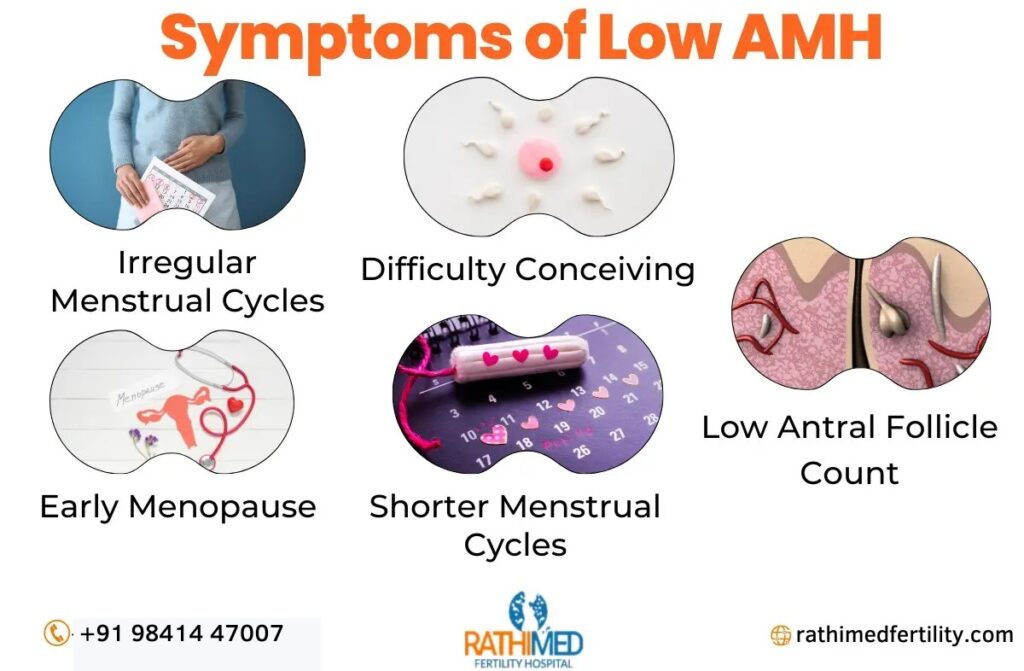
Low AMH itself rarely causes noticeable symptoms — it’s usually picked up through blood work rather than how a woman feels day to day. That said, certain patterns should prompt an evaluation:
- Difficulty conceiving after several months of trying
- A history of recurrent miscarriage
- A weaker-than-expected response to ovarian stimulation in a previous fertility cycle
- A family history of early menopause, which can sometimes prompt earlier AMH testing
Irregular periods or hormonal symptoms aren’t typically caused by low AMH on their own, though they can point to a related condition worth investigating alongside it. If any of these apply to you, it’s worth booking an evaluation rather than waiting — early, accurate diagnosis is the foundation of effective low AMH treatment in Chennai.
What Causes Low AMH?
Several factors can drive down ovarian reserve, including:
- Age — the natural decline that speeds up after the mid-30s
- Diet and weight — poor nutrition and obesity are linked to lower AMH
- Endometriosis — inflammation and tissue damage affecting the ovaries
- PCOS — hormonal imbalance from polycystic ovary syndrome can disrupt normal ovarian function
- Genetics — a family history of low AMH or early menopause
- Autoimmune conditions — where the immune system affects ovarian tissue
- Cancer treatment — chemotherapy and radiation can damage follicles
- Ovarian surgery — previous surgery for cysts or endometriomas can reduce healthy ovarian tissue
- Chronic stress — long-term stress disrupts hormonal balance
- Lifestyle factors — smoking, obesity, environmental pollutants, and vitamin D deficiency
How Low AMH Is Diagnosed
A proper diagnosis combines a few tests rather than relying on AMH alone:
- Blood test — direct measurement of AMH level, which can be done on any day of the cycle
- Antral Follicle Count (AFC) — an ultrasound count of visible follicles, usually done early in the cycle
- FSH and estradiol levels — tested together to add context to ovarian function, typically on day 2 or 3 of the cycle
- A full fertility history review — cycle regularity, past pregnancies or losses, and any prior fertility treatment
Getting these done together, rather than in isolation, gives a much clearer picture — which is why thorough diagnostics are the starting point for any credible low AMH treatment in Chennai.
Treatment Options for Low AMH
Once the picture is clear, treatment is built around what will realistically help your reserve and age group:
- Fertility evaluation — a full baseline assessment before any intervention begins
- Hormonal support — medications such as DHEA, sometimes combined with other agents, used to support egg quality ahead of stimulation
- IVF with individualized stimulation — protocols adjusted specifically for a lower egg yield, aimed at maximizing what’s retrievable
- Mini-IVF or low-dose stimulation protocols — a gentler approach sometimes used for very low responders to reduce medication burden while still aiming for viable embryos
- Egg freezing — a way to preserve current egg quality if you’re not ready to conceive yet
- Donor eggs — a well-established option when own-egg IVF isn’t likely to succeed
- Lifestyle and nutritional support — diet, targeted supplements, and stress management alongside medical care
This is also where low AMH treatment for pregnancy in Chennai differs most between clinics — the difference usually comes down to how personalized the stimulation protocol is, not just which drugs are used.
What to Expect from IVF with Low AMH
Many patients want a realistic picture before starting, not just reassurance. A few honest points worth knowing:
- Fewer eggs are typically retrieved per cycle, so your doctor may discuss the possibility of more than one stimulation cycle before a transfer.
- Embryo quality matters more than embryo quantity — even a small number of good-quality embryos can lead to a successful pregnancy.
- Protocol choice matters a great deal. Standard high-dose protocols don’t always suit low responders; many specialists use antagonist or mild-stimulation protocols instead, tailored to how your ovaries actually respond.
- Monitoring is more frequent in low-reserve cycles, since the margin for adjusting medication in real time is smaller.
A transparent specialist will walk you through these realities upfront rather than only presenting the best-case scenario.
Can You Naturally Improve AMH Levels?
AMH declines with age and can’t be reversed, but certain habits may help support the follicles you do have and improve how your body responds to treatment:
- Eat well — antioxidants, omega-3s, and folate from leafy greens, fish, nuts, and berries support ovarian health
- Consider supplements — DHEA and CoQ10 are commonly discussed with a specialist for ovarian support
- Manage stress — yoga, meditation, and regular sleep help keep hormone levels steadier
- Stay active — moderate exercise supports overall hormonal balance
- Limit toxin exposure — cutting back on BPA, phthalates, smoking, and alcohol protects ovarian function over time
- Maintain a healthy weight — both very low and very high body weight can affect hormonal balance and ovarian response
None of these will dramatically raise a lab number on their own, but combined with the right medical plan from a low AMH treatment in Chennai provider, they give your body the best possible starting point.
Does vitamin D help increase AMH?
There’s no universal dosage proven to raise AMH specifically, but some research suggests women with low AMH may benefit from 2,000–4,000 IU of vitamin D daily. Confirm the right dose with your doctor based on your blood levels — more isn’t automatically better.
Does folic acid increase AMH?
Not directly. Folic acid supports general reproductive health and is a standard part of fertility treatment, but it hasn’t been shown to raise AMH on its own.
Do specific fruits raise AMH levels?
No single fruit boosts AMH directly. Antioxidant-rich fruits like berries, oranges, and avocados support overall reproductive health as part of a balanced diet, which is a helpful complement to treatment rather than a substitute for it.
Does CoQ10 actually help with low AMH?
Some studies suggest CoQ10 may support mitochondrial function in eggs, which could help with egg quality during stimulation, though evidence on raising AMH itself is limited. It’s generally considered a reasonable, low-risk addition alongside medical treatment — discuss dosage with your specialist.
Low AMH and Your Chances of Pregnancy
A low AMH result narrows the margin, but it doesn’t close the door. What it usually means in practice:
- Fewer eggs, not necessarily worse eggs — many women with low reserve still produce good-quality eggs, especially if they’re younger
- Earlier evaluation matters — since reserve continues to decline, timely testing avoids losing options unnecessarily
- IVF is often the most effective route, especially with a protocol tailored to a lower expected yield
- Egg freezing remains a reasonable choice for anyone not ready to try immediately
- Age remains the biggest single factor in outcome, even more than the AMH number itself
Working with an experienced low AMH specialist in Chennai makes the biggest difference here — the right protocol, chosen early, is often what separates a difficult cycle from a successful one.
Emotional Wellbeing During Treatment
A low AMH diagnosis can bring anxiety, grief, or a sense of urgency that’s hard to sit with. This is a normal response, not a sign that something is wrong with how you’re coping. A few things that help:
- Talk to your specialist about timelines, not just numbers — understanding your realistic window often reduces anxiety more than the AMH figure itself
- Consider counseling support, which many fertility clinics offer alongside medical treatment
- Connect with a support community, in person or online, of others going through similar treatment
- Involve your partner in appointments where possible, so decisions are made together rather than carried alone
Preparing for Your First Consultation
Coming prepared can make your first visit far more productive:
- Bring any prior test results, including previous AMH, FSH, or ultrasound reports
- Note your menstrual cycle history, including regularity and any recent changes
- List current medications and supplements you’re taking
- Write down your questions in advance — it’s easy to forget them in the moment
- Be ready to discuss your timeline and priorities, since this shapes which options your doctor recommends first
Choosing the Right Specialist
Not every fertility clinic approaches diminished ovarian reserve the same way. When evaluating a low AMH specialist in Chennai, it’s worth asking about:
- Their experience specifically with low-reserve and poor-responder cases
- Whether stimulation protocols are individualized or standardized
- Lab success rates for patients in a similar AMH range and age group
- How they communicate realistic expectations versus best-case outcomes
- Clarity on cost and what’s included at each stage
Clinics with genuine experience in low AMH treatment in Chennai will usually be upfront about realistic success rates rather than making broad promises — that transparency is itself a good sign.
Why Patients Choose Rathimed Fertility Centre
At Rathimed Fertility Centre in Anna Nagar, low-reserve cases are treated as their own category rather than folded into a standard IVF pathway. That means:
- Individualized stimulation protocols based on your specific AMH, AFC, and age
- Clear, honest conversations about odds and timelines before treatment begins
- Access to the full range of options — from lifestyle support through IVF to donor-egg pathways — so you’re never limited to a single path
- Transparent, itemized cost estimates before you commit to a protocol
Low AMH Treatment Cost in Chennai
Cost varies depending on what your case actually needs, but the main components are usually:
- Consultation fees for initial evaluation and follow-ups
- Diagnostic tests — bloodwork, AFC ultrasound, and related screening
- Medication costs — hormonal drugs for stimulation or support, which can vary widely by protocol and dosage
- Procedure fees — for IVF, IUI, or other ART procedures, including egg retrieval, embryo transfer, and laboratory services
- Additional costs — anesthesia, embryo freezing/storage, and follow-up consultations
Factors that move the price up or down include clinic reputation, the specific treatment chosen, how many diagnostic or stimulation cycles are needed, the doctor’s experience, and what your insurance covers. A transparent clinic will walk you through an itemized estimate before you commit — ask for this upfront when comparing options for low ovarian reserve treatment in Chennai.
Conclusion
A low AMH result is a starting point for a conversation, not a verdict. With early diagnosis, an individualized protocol, and guidance from an experienced team, low AMH treatment in Chennai can meaningfully improve your chances of conceiving. If you’ve recently been diagnosed with low AMH or simply want a clearer picture of your options, the team behind low AMH treatment in Chennai at Rathimed Fertility Centre in Anna Nagar is ready to build a plan around your specific reserve, age, and goals.
Read also Best Fertility Hospital in Chennai.